
Thermocycler: what it does and how to choose one
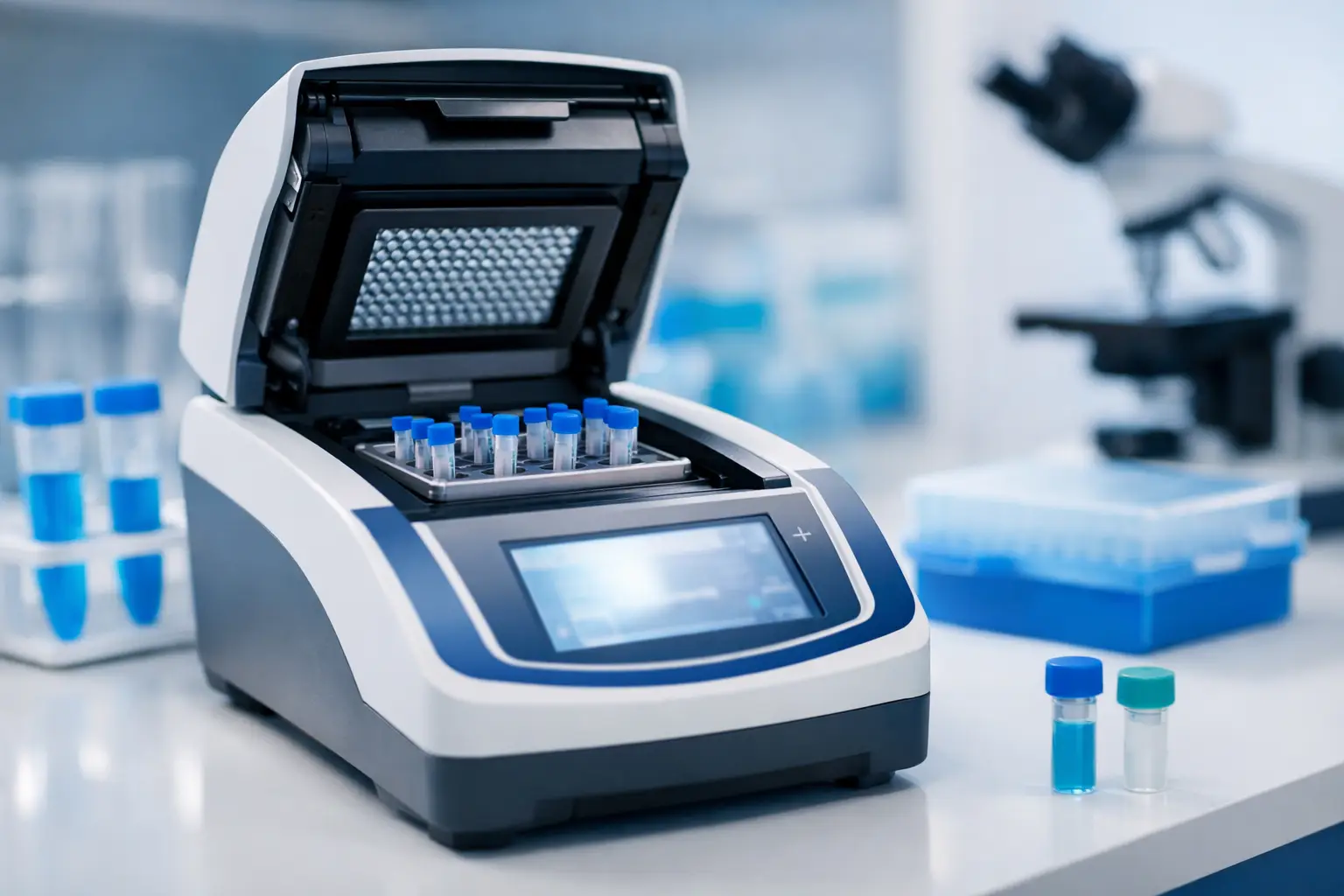
When a PCR fails, the reagents are rarely the only factor. Temperature uniformity, ramp speed and instrument stability can all affect performance. Understanding what a thermocycler does is therefore about more than defining the equipment: it means knowing how it influences reproducibility, method performance and the laboratory’s daily workload.
What a thermocycler does in the laboratory
A thermocycler is a laboratory instrument that exposes biological samples to precise, programmed temperature cycles. Its best-known application is the polymerase chain reaction (PCR), where it alternates between denaturation, annealing and extension steps to amplify DNA fragments.
In practice, its job is more than heating and cooling. A good thermocycler should distribute temperature evenly across the wells, limit variation between runs and maintain stable control throughout demanding programmes. In diagnostics, research and quality control, that consistency can make the difference between an interpretable result and an unnecessary repeat.
It is also useful to distinguish conventional thermocyclers from real-time PCR systems. Both use similar thermal cycling principles, but qPCR instruments also include an optical system to monitor amplification as it happens. This affects the application, software and validation requirements.
What thermocyclers are used for
The main application of thermocyclers is nucleic acid amplification. They are commonly used in molecular biology, microbiology, genetics, clinical diagnostics, veterinary science, food safety, the pharmaceutical industry and university laboratories.
In research, they support cloning, genotyping, gene expression analysis using RT-PCR or qPCR, sequencing and mutation studies. In microbiology and diagnostic laboratories, they can help detect pathogens, confirm genetic identities and support screening protocols. In industrial quality control, they can be used to identify microbial contamination and check raw materials or finished products.
A thermocycler turns a complex protocol into a repeatable process. The user sets the temperatures, times and number of cycles, and the instrument runs the programme. This reduces variation from manual handling and helps standardise work across technicians, shifts and sites.
How a thermocycler works
A thermocycler has a thermal block that holds tubes, strips or plates. The block changes temperature according to a predefined programme. In conventional PCR, a typical cycle includes DNA denaturation, primer annealing and extension by the polymerase.
Reaching the target temperature is only part of the job. The instrument also needs to reach it quickly and maintain it uniformly. If temperatures vary significantly between positions in the block, the same reaction may behave differently from one well to another. This matters particularly for sensitive methods.
Some models include a heated lid to prevent condensation, a gradient function to help optimise protocols, and programme memory for repetitive workflows. In laboratories with a high sample throughput, these features can save time and reduce setup errors.
Types of thermocyclers
Not every laboratory needs the same instrument. The right choice depends on the assay, sample volume and traceability requirements.
Conventional thermocyclers
These are widely used for standard PCR. They run thermal programmes without optical detection and can meet many needs in basic research, teaching, method development and routine analysis when real-time quantification is not required.
Models differ in capacity, such as 96-well or 384-well blocks, interchangeable blocks, ramp speed and programming options. A basic model may be sufficient for a small laboratory. For a high-throughput setting, operational reliability and repeatability between runs are particularly important.
Gradient thermocyclers
Gradient thermocyclers apply a range of temperatures across different block columns during the same run. This is especially useful for optimising annealing temperatures and adjusting new assays. The feature can be valuable when a laboratory develops methods, validates primers or works with variable sample matrices.
Real-time PCR systems
Although they are often discussed alongside conventional thermocyclers, real-time PCR systems meet a different need. Alongside thermal control, they include fluorescence detection and analysis software. They are used for quantification, gene expression studies, viral load measurement, pathogen detection and other applications where knowing whether amplification occurred is not enough.
For these systems, selection involves more than the thermal block. Optical sensitivity, available channels, data analysis and compatibility with the laboratory’s kits and assays also matter.
What to assess before choosing a thermocycler
In a business-to-business purchase, focusing only on the initial purchase price can be a poor decision. A thermocycler is part of the laboratory’s critical workflow, so its performance affects turnaround times, repeat runs, validation and maintenance.
Temperature uniformity is one of the most important criteria. Poor temperature distribution can affect reproducibility between samples. Accuracy and ramp speed also matter, although their priority depends on the method. The fastest instrument is not always the best fit: for some protocols, stability matters more than speed.
Choose a block capacity that matches the actual workload. An oversized block may leave capacity unused, while an undersized one can create bottlenecks. Check compatibility with the required consumable formats, ease of programming, user interface and options for saving validated methods.
In regulated laboratories or settings with documentation requirements, software, traceability and access to technical support can be decisive. A capable instrument with poor after-sales support can create more problems than it solves. Assess both the instrument’s features and the technical support available.
Common mistakes when selecting a thermocycler
One common mistake is choosing solely for the current application. If the laboratory expects to process more samples, introduce new assays or use different formats, plan for those needs. Replacing an instrument too soon adds to the total cost of ownership and may require processes to be revalidated.
Another mistake is assuming that all thermocyclers perform equally. Instruments can look similar on paper but differ in temperature uniformity, ease of use, operating noise, long-term reliability and technical support.
Compatibility with the rest of the workflow is easy to overlook. The instrument should work with available consumables, staff routines and the laboratory’s documentation requirements. A high-performing thermocycler that is awkward to use every day can create unnecessary friction.
When to replace a thermocycler
There is no need to wait for a breakdown. Operational problems can also be a reason to replace a thermocycler, including excessively long run times, an outdated interface, poor temperature uniformity, insufficient capacity or the lack of features that have become necessary, such as gradient control or connectivity.
Other signs are less direct. More repeat runs without a clear analytical cause, greater variation between block positions or increasingly frequent maintenance may indicate a problem with thermal performance. Continuing to rely on the instrument is not always the most practical option.
When planning a replacement, review not only the instrument’s condition but also how well it matches the laboratory’s workload and likely development. The right decision balances technical requirements, operational continuity and the total cost of use.
Thermocyclers in the daily laboratory workflow
Thermocyclers do more than run PCR. They help standardise critical processes, shorten method optimisation, improve repeatability and support methods that depend on reliable temperature control. This matters in laboratories working to tight deadlines, handling audits or processing high sample volumes.
Choosing a thermocycler is therefore not just an equipment purchase. It is a decision about analytical continuity. At Letslab, the practical approach is to match the instrument to the application, workload and actual conditions of use, rather than relying on specifications alone.
For occasional PCR work, a suitably sized conventional model may be enough. If the laboratory develops methods, processes samples intensively or needs quantification and advanced traceability, the requirements change. Compare options against the laboratory’s technical needs.
The best choice is usually the one that helps prevent problems before they occur. That is the role of a well-selected thermocycler: to help the method perform as intended every time it runs.
Related products and categories
You may also be interested in:
Not sure which one is right for you?
We have been equipping laboratories since 2008. Tell us what you need it for and we will tell you what to buy and what you can do without.
Talk to a specialist