
Wooden test tube clamp: uses and alternatives
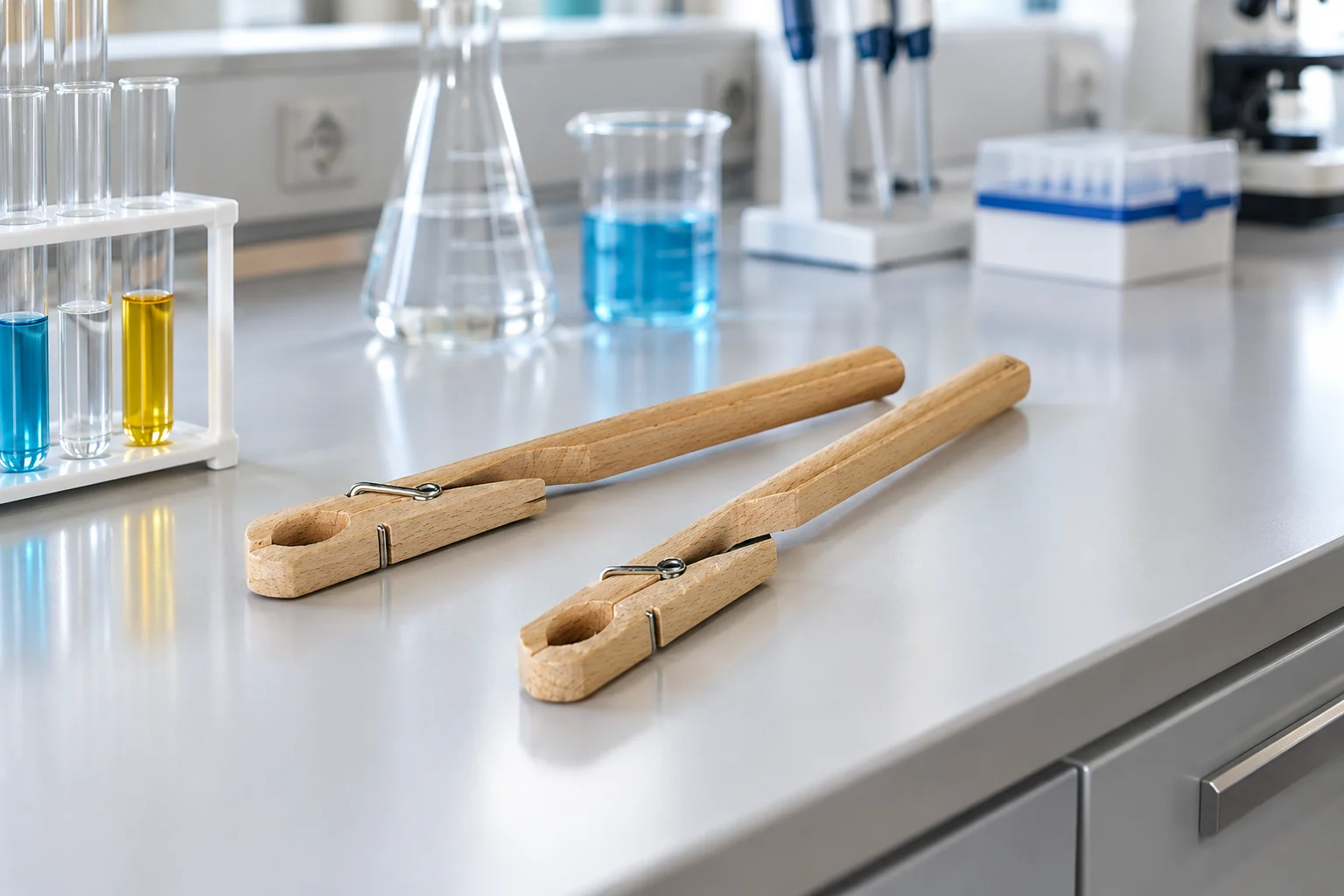
A wooden test tube clamp has one specific job: holding a test tube that is being heated over a flame without burning your fingers. It is not a substitute for a support clamp used to keep a burette vertical or hold a condenser during distillation, because it does not attach to a stand. Before buying one, check that it suits the task you have in mind.
What is a wooden test tube clamp used for?
This is a hand-held test tube clamp. You squeeze it with your fingers to open it, and a spring closes it again when you release it. It holds a test tube while you heat it over a burner, shake it or transfer its contents. Wood acts as a thermal insulator, so heat from the glass does not travel up the handle to your hand.
Typical uses include:
- Heating a test tube directly over a Bunsen or alcohol burner.
- Removing a test tube from a water bath or heating block.
- Holding a tube while adding a reagent, mixing its contents or observing a reaction.
- Transferring the contents of a hot tube to another vessel.
That makes the wooden test tube clamp a familiar tool in school and undergraduate practicals. It is simple to handle with one hand, does not break easily and does not conduct heat to your fingers. It is less common in professional analytical laboratories, where direct flame heating of test tubes has largely given way to baths, heating blocks and hot plates.
What to check before buying one
It is a simple tool, but three details make the difference between a useful clamp and one that ends up in the bin:
- The spring. This is often the first part to fail. If it loses tension, the tube can slip. Check that the clamp closes firmly and returns to the closed position when released.
- Contact with the glass. The jaws should follow the curve of the tube rather than grip it at two isolated points. A hot tube held at two points can become marked and is more likely to crack under thermal shock.
- Handle length. A longer handle keeps your hand further from the flame. With a very short clamp, your knuckles have to be closer to the burner.
One practical point that may not appear on the label: wood is combustible. If you bring the handle close to the flame, it will char. Grip the upper part of the tube and heat its lower third, keeping the tube tilted with its opening pointed away from you and your colleagues.
When not to buy a wooden test tube clamp
These are the situations where a wooden clamp is often the wrong choice:
- If you just want to keep test tubes upright and organised, use a test tube rack. It is a better fit for the job and leaves your hands free.
- If a test tube, burette or condenser needs to stay in position for minutes or hours, a wooden clamp will not work: it cannot attach to a support rod or bosshead. You need a metal clamp that attaches to a stand.
- If you work with concentrated acids or splashing solvents, wood can absorb them. A metal clamp with plastic-coated tips can be cleaned, while an impregnated wooden clamp has to be discarded.
- If you heat samples in a bath, on a hot plate or in a block rather than over a direct flame, the thermal insulation of wood is less of an advantage and other clamps are more versatile.
Metal clamps for a burette stand or condenser
When you need to keep something in a fixed position, such as a burette during a titration, a condenser during reflux or a thermometer inside a reactor, choose a metal clamp secured to the support rod with a bosshead. The clamps and stands category at Letslab includes chrome-plated metal clamps, a finish that withstands moisture and splashes without pitting.
The main differences between the clamps are the diameter range they hold and how they contact the glass.
| Model | Diameter | Contact with glass | Suitable for |
|---|---|---|---|
| Pinza para buretas y termómetros metal cromado cierre muelle Ø 0-25 mm | Ø 0 to 25 mm | Chrome-plated metal | Thermometers, narrow tubes and setups that are changed frequently |
| Trips Burette Clamp | Ø 4 to 20 mm | Chrome-plated metal | Burettes, chromatography columns and rods |
| Clamp for burettes and tubes | Ø 7 to 25 mm | PVC-coated tips | 10, 25 and 50 ml burettes and tubes, with protection for the glass |
| Clamp for burettes and condensers | Ø 12 to 45 mm | PVC-coated tips | Condensers, distillation and reflux |
Spring-loaded or adjustable opening
The Pinza para buretas y termómetros metal cromado cierre muelle Ø 0-25 mm closes automatically under spring tension. Place the item in the clamp and it grips without needing to turn an adjustment. It is useful for teaching and for setups that are dismantled regularly. Its 0 to 25 mm range covers items from thermometers to test tubes and burettes.
The Trips Burette Clamp works differently: its opening is adjustable from 4 to 20 mm, allowing you to set the position and keep it there. It is a practical choice if you work with the same diameter each time and need a burette to stay in place between titrations.
When PVC-coated tips are useful
Metal grips glass securely, but can mark it if you apply too much force. Plastic-coated tips distribute the pressure and provide grip, which is useful with delicate or frequently used glassware. The Clamp for burettes and tubes has a rigid joint with no play and PVC at the contact point. It is a suitable option for a 50 ml burette used daily.
For distillation and reflux setups, consider the diameter range. The Clamp for burettes and condensers opens to 45 mm to hold a condenser and closes down to 12 mm for a burette. It is the most versatile choice if you are buying just one clamp.
Check for overlapping diameter ranges
The ranges overlap: 0 to 25, 4 to 20, 7 to 25 and 12 to 45 mm. There is little reason to buy three clamps that do nearly the same job. For teaching where you mainly hold burettes and tubes, the 7 to 25 mm model is sufficient. If you also set up condensers, add the 12 to 45 mm model. If you need to hold very narrow thermometers, the spring-loaded clamp covers smaller diameters than the others.
Practical summary
- Heating test tubes over a flame and moving them by hand: use a wooden test tube clamp.
- Keeping test tubes upright and organised on the bench: use a test tube rack.
- Holding something fixed on a stand: use a metal clamp and choose the right diameter range.
- Delicate glassware or glassware used daily: choose PVC-coated tips.
If a wooden test tube clamp is not suitable once your setup needs to stay in place, the Clamp for burettes and condensers is a versatile alternative. Its broad diameter range and PVC-coated tips are designed for holding glassware without marking it.
Not sure which one is right for you?
We have been equipping laboratories since 2008. Tell us what you need it for and we will tell you what to buy and what you can do without.
Talk to a specialist