
Benchtop autoclaves with prevacuums: the Raypa H23 guide
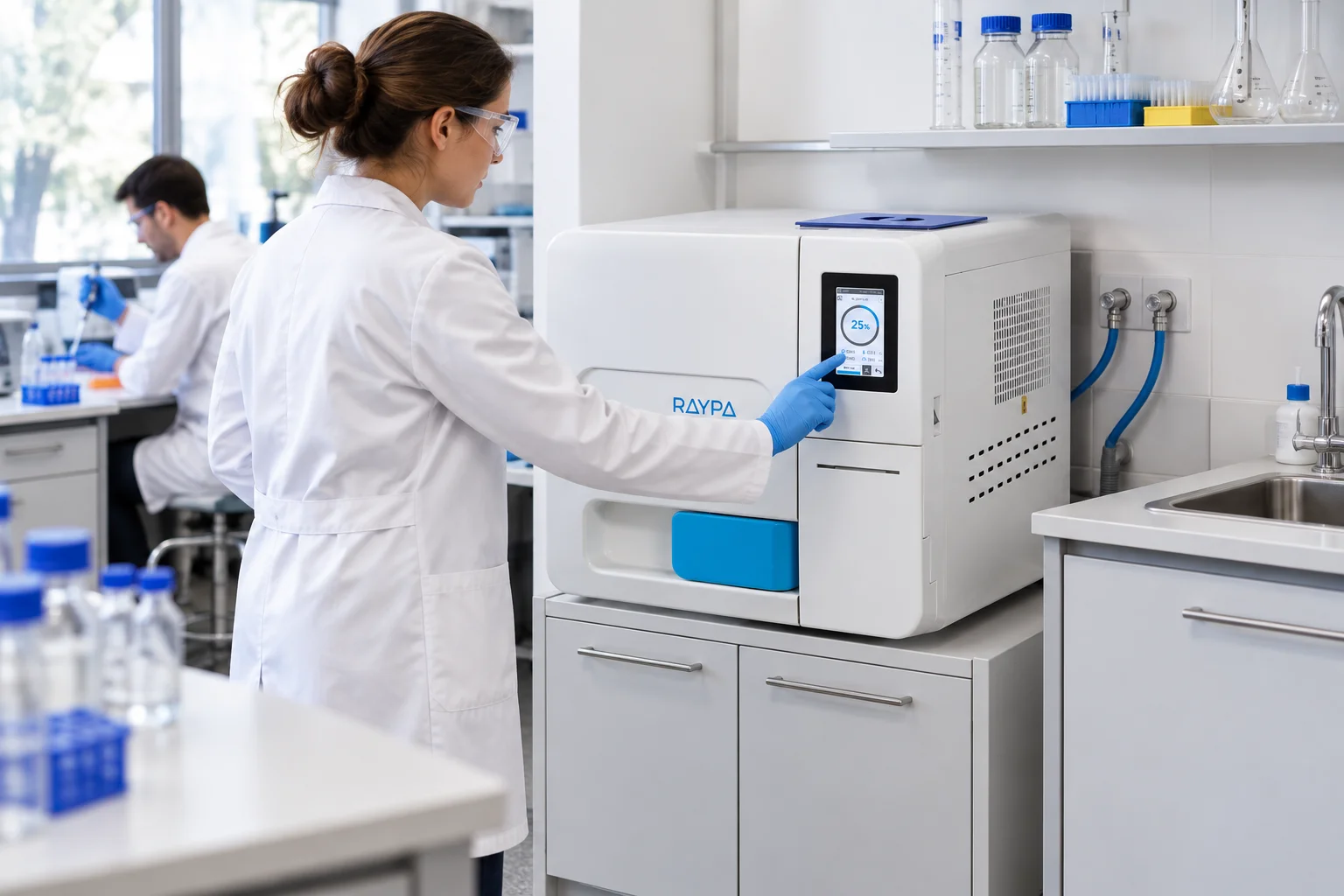
For a small laboratory moving on from a pressure cooker or a manual-air-purge unit, benchtop autoclaves with prevacuums can make it possible to process wrapped instruments, waste bags, textiles and hollow items. The issue is not simply reaching 121 °C: air trapped inside a load can stop steam reaching every surface. The Raypa H23 is a 23 L benchtop autoclave with pre-vacuum and vacuum drying, designed as an entry-level option for this step up.
Benchtop autoclaves with prevacuums: why air removal matters
In an autoclave without vacuum, steam displaces air from the chamber and pushes it out through the vent. This works well for open loads with a simple shape, such as uncapped flasks containing culture medium or loose solid items on a tray.
Air is harder to remove from a textile pack, a closed sterilisation bag, a pipette lumen or a hinged instrument. A pocket of cool air can remain where steam cannot reach. That area may not reach the sterilisation temperature, even if the chamber pressure gauge and temperature sensor show the expected readings.
Pre-vacuum removes air before steam enters the chamber. The process can be repeated in pulses, alternating vacuum with steam, until little air remains in the load. The H23 can be set for 1 to 10 pre-vacuum pulses, allowing the cycle to be adjusted to how compact or enclosed the load is.
When do you really need pre-vacuum?
- Porous materials such as textiles, gauze, filters and cellulose plugs.
- Wrapped or pouched items that need to come out sterile and be stored.
- Complex shapes such as hinged instruments, tubing and narrow hollow items.
- Compact loads where items can shield one another.
When is pre-vacuum unnecessary?
Pre-vacuum does not help with liquids and is contraindicated for them. The H23 can be set to 0 pulses for these cycles. If you only sterilise culture media in bottles, water, buffers and unpackaged biological waste, vacuum may not add anything to your process. In that case, browse the laboratory autoclaves category and consider a manual-purge unit or one that simply adds a drying phase.
Raypa H23 specifications
Check the chamber dimensions and the unit’s weight against your actual needs before making a decision.
- Chamber: 23 L total capacity and 21 L usable capacity, stainless steel, Ø 245 x 450 mm.
- Configuration: horizontal benchtop, front loading, with space for up to 5 trays.
- Temperature: 105 to 134 °C. Sterilisation time: 4 to 60 min.
- Pre-vacuum: 1 to 10 pulses, or 0 for liquids. Includes an initial preheating phase.
- Vacuum drying: 3 to 60 min, for solid loads only.
- Pressure: 2.4 Barg.
- Steam: integrated generator.
- Tanks: separate 4 L clean-water and 2.2 L waste-water tanks.
- Control and records: 4.3-inch touchscreen, integrated printer and data recording to an SD card.
- Tests: Bowie-Dick, vacuum and Helix tests.
- Electrical and physical: 230 V, 1,950 W, 55 kg, 500 x 650 x 430 mm.
- Installation: plug and play, requiring an electrical connection.
What the specifications mean in everyday use
The cylindrical chamber, Ø 245 x 450 mm, determines what will fit. Its 21 L usable capacity can suit trays of instruments and pouched items better than tall bottles. Measure the largest container you regularly sterilise and check it against the chamber diameter before choosing the unit.
At 55 kg and 500 x 650 x 430 mm, the H23 needs a stable bench or worktop that can support its weight, with enough space in front for the door. It is not designed to be moved every week.
The integrated steam generator and plug-and-play setup mean no steam supply or mains water connection is required. You need a 230 V socket. Separate clean-water and waste-water tanks help prevent contaminated condensate from returning to the clean-water circuit.
The integrated printer and SD card data recording can be useful when your laboratory needs a record of each cycle. The cycle can be documented on paper and as a file. The Bowie-Dick test checks steam penetration in a porous load, the vacuum test checks whether the vacuum system maintains its seal, and the Helix test assesses penetration into hollow items. These are periodic verification checks that may be requested during an audit.
When the H23 may be too small
Consider two limits: capacity and chamber format. If you process large batches of media or several instrument loads each day, 21 L of usable capacity may mean running successive cycles. Anything that will not fit inside a 245 mm diameter cylinder cannot be processed in this chamber.
For larger loads, Raypa’s vertical range includes the 75 L AE-75-B and 110 L AE-110-B models. Both are Class B units with an AISI-316L stainless steel chamber and lid, an integrated steam generator and configurable fractionated pre-vacuum with 1 to 3 cycles. The 110 L model adds 50 programmes, including 12 preset and 38 editable programmes. These are higher-range units than the H23.
If you need more capacity and drying but not fractionated pre-vacuum, the 50 L AE-50-DRY is a Class S vertical autoclave. Its chamber, tank, lid and closure are made of AISI-304 stainless steel. It has 10 programmes, 6 of which are configurable, and is suitable for pouched and unpackaged solids, glass, plastic, metal instruments, liquids, culture media and biological waste bags.
Quick comparison
| Model | Capacity | Format | Vacuum | Drying | Temperature |
|---|---|---|---|---|---|
| Raypa H23 | 23 L, 21 L usable | Horizontal benchtop, front loading | Pre-vacuum, 1 to 10 pulses, 0 for liquids | Vacuum drying, 3 to 60 min, solids only | 105 to 134 °C |
| Raypa AE-50-DRY | 50 L | Vertical | Manual air purge | Yes, at the end of the cycle | 105 to 134 °C |
| Raypa AE-75-B | 75 L | Vertical | Fractionated vacuum, 1 to 3 cycles | Yes, at the end | 105 to 134 °C |
| Raypa AE-110-B | 110 L | Vertical | Fractionated pre-vacuum, 1 to 3 cycles | Yes | 105 to 134 °C |
Three checks to make before ordering
1. Measure the load you actually sterilise
Take the largest flask, instrument case or bag you process and compare it with the chamber dimensions of Ø 245 x 450 mm. If it fits with room to spare and the trays you need fit within the five-tray capacity, the format may suit your work.
2. Decide whether you will use the drying function
Vacuum drying runs for 3 to 60 min and applies to solid loads only. If your items are used hot straight after the cycle, or you only sterilise liquids, this function may not be useful for your process.
3. Check the bench, socket and records you need
Allow for a stable surface that can support 55 kg and a 230 V supply for 1,950 W. No building work or mains water connection is required. The printer and SD card are included for laboratories that need cycle records.
Who is the H23 for?
The H23 is intended for laboratories buying their first autoclave with pre-vacuum, replacing a pressure cooker or manual-purge unit, or needing to process wrapped or porous items with cycle records without installing a dedicated steam supply. It is an entry-level Raypa model with an operating range of 105 to 134 °C and a pressure of 2.4 Barg.
Letslab has sold laboratory equipment online since October 2008 and offers more than 50,000 products. The team also delivers and commissions equipment. Check the chamber dimensions, load requirements and installation conditions against your laboratory before choosing the Raypa H23.
Not sure which one is right for you?
We have been equipping laboratories since 2008. Tell us what you need it for and we will tell you what to buy and what you can do without.
Talk to a specialist