
Blog · Pesafiltros y vidrios de reloj
Watch glass lab guide: choosing material and diameter
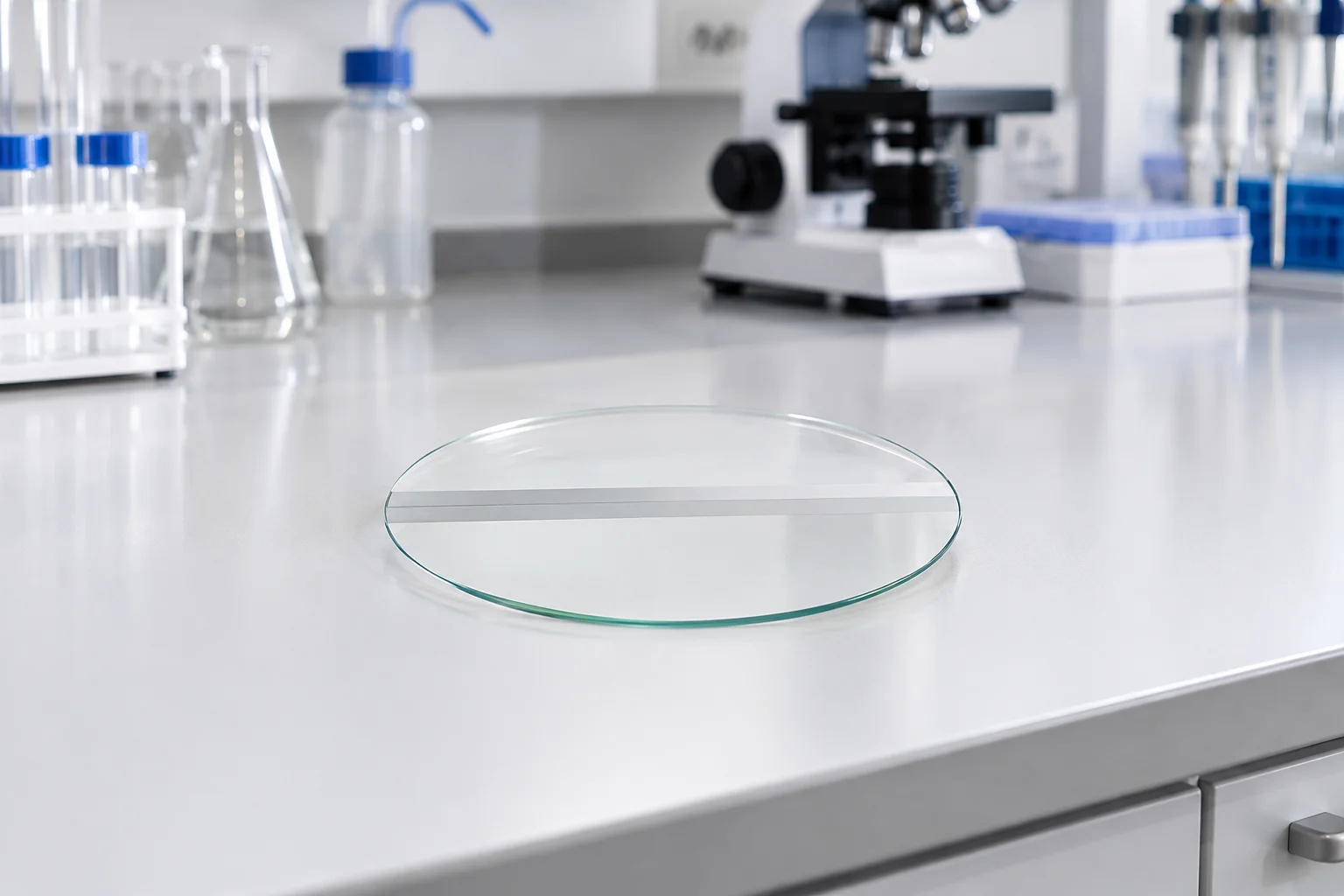
This watch glass lab guide compares materials, diameters and uses so you can choose the right piece for your work. A watch glass can crack when used as a cover on a hot plate, be damaged by concentrated chemicals, slide around on the bench or make repeated weighing awkward. Before choosing one, consider its material and diameter, and whether a watch glass is actually the right tool for your sample.
Watch glass lab uses and material choices
A watch glass is a shallow, concave piece with no rim or feet. In the lab, it is commonly used to:
- Cover beakers and crucibles during heating, reducing evaporation without sealing the vessel.
- Weigh solid samples on an analytical balance. The concave shape helps keep the solid from spilling while you handle it.
- Evaporate small volumes and collect precipitates after filtration.
These uses are not interchangeable in every situation. The sample chemistry and working temperature determine which material is suitable.
What is a watch glass made of?
Soda glass for general use
Soda glass is the conventional choice for routine and teaching laboratories. It is transparent, easy to clean and inspect, and suitable for most general laboratory tasks. Watch Glass Soda Glass is suitable for covering beakers and crucibles, weighing solids and small-scale evaporation.
It is not recommended for concentrated acids or strong bases. If your work involves HF, hot caustic solutions or chlorinated solvents, choose another material. Soda glass can also break if dropped, potentially losing both the watch glass and the sample being weighed.
Polypropylene when breakage is a concern
Polypropylene Watch Glass, Autoclavable — 60, 80 and 100 mm is a practical option in teaching, routine testing and microbiology laboratories where glassware is handled frequently and breakage is a recurring problem.
It is autoclavable and available in 60, 80 and 100 mm diameters. Its moulded base helps it stay steady on the bench without a ring or support. The non-absorbent surface also helps maintain a consistent tare between units, which is useful when weighing samples in a series.
Polypropylene does not tolerate the temperatures that glass or PTFE can withstand. Do not use it as a cover on a beaker being heated on a hot plate. It is suitable for weighing, slow evaporation and covering vessels at room temperature.
PTFE for chemically aggressive work
PTFE Watch Glass — Isostatic Moulding, FDA Approved is made from pure PTFE using isostatic moulding, producing a uniformly dense, pore-free piece. This matters in trace analysis, where material can absorb traces and affect the blank.
The watch glass is FDA approved, has a maximum working temperature of 280 °C and resists acids, bases and solvents. It also resists thermal shock. Choose it for work involving HF, hot concentrated bases or chlorinated solvents, where soda glass can deteriorate.
Compare watch glass lab equipment by material
| Material | Suitable for | Key features |
|---|---|---|
| Soda glass | General use, covering and weighing | Transparent and easy to inspect |
| Polypropylene | Teaching, routine work and autoclaving | Autoclavable, moulded base and consistent tare; 60, 80 and 100 mm |
| Pure PTFE, isostatically moulded | Aggressive chemicals and work up to 280 °C | Resistant to acids, bases and solvents; pore-free |
When a watch glass is not the right choice
For a hygroscopic sample, use a weighing bottle
A watch glass is open, so a hygroscopic solid can gain weight between being removed from a desiccator and being placed on the balance. For this task, use a lidded container such as the Cylindrical Polypropylene Weighing Bottle with Lid, Transparent. Its airtight lid helps prevent moisture absorption while the sample is being transferred.
A weighing bottle can also be used to weigh filters after gravimetric filtration and to handle reagents sensitive to moisture in the air. Polypropylene resists common solvents and weighs less than glass, which can be useful when carrying out repeated weighings in analytical or quality-control work.
For covering a vessel at room temperature
PTFE is not necessary for this use. Soda glass is suitable, or choose polypropylene if breakage is a frequent problem. Reserve PTFE for applications involving aggressive chemicals or high temperatures.
For shared equipment in a busy laboratory
In teaching laboratories and workplaces where several people handle the same glassware, consider replacement needs as well as the individual item. Polypropylene avoids glass breakage and, because it is autoclavable, can be included in the sterilisation cycle.
To cover a beaker, measure before choosing a diameter
Do not choose a watch glass by eye. One that is too small may not rest on the rim and can fall into the beaker; one that is too large can be awkward to handle with forceps. Measure the vessel’s outside diameter and select a watch glass that is slightly larger. The polypropylene model is available in 60, 80 and 100 mm diameters.
Practical details to check before buying
- Base shape: the moulded base on the polypropylene model helps keep it steady on the bench. A traditional soda glass watch glass can roll.
- Tare: for repeated weighing, a consistent tare between units saves a step in each cycle.
- Cleaning: the non-absorbent polypropylene surface and pore-free, isostatically moulded PTFE help reduce carryover between samples.
- Quantity: watch glasses are often used in batches. Keeping several available helps ensure one is ready when needed.
Which watch glass should you choose?
- General use, weighing and covering vessels: soda glass.
- Teaching, frequent breakage or autoclaving: polypropylene, in 60, 80 or 100 mm.
- Concentrated acids, strong bases, aggressive solvents or work up to 280 °C: PTFE.
- Hygroscopic samples or filters after gravimetric filtration: choose a weighing bottle with a lid instead of a watch glass.
Browse the weighing bottles and watch glasses category to compare the available options.
For a laboratory that weighs samples daily and regularly replaces broken glassware, the Polypropylene Watch Glass, Autoclavable — 60, 80 and 100 mm is a practical option, with a moulded base, consistent tare and three diameters for different vessels.
Not sure which one is right for you?
We have been equipping laboratories since 2008. Tell us what you need it for and we will tell you what to buy and what you can do without.
Talk to a specialist