
Digital Thermo Hygrometer: What to Check Before Buying
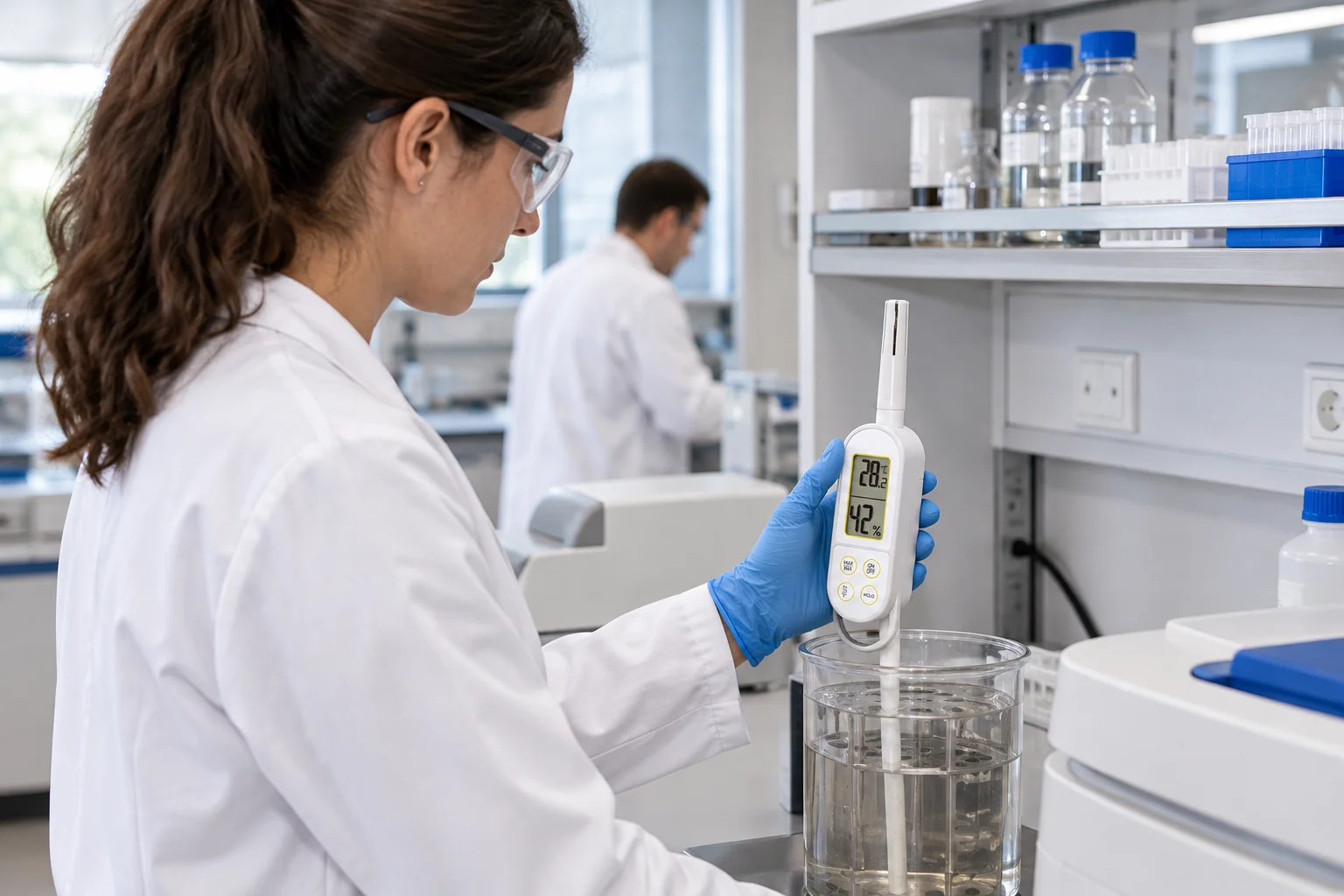
Choosing a digital thermo hygrometer can go wrong for one common reason: people compare the display and appearance instead of checking what determines whether the instrument is right for the job. That means looking at humidity sensor accuracy and where you take the measurement. A device showing temperature to one decimal place may look precise, but if its humidity sensor has a wide tolerance and sits next to a warehouse wall above a radiator, the reading may not represent the room.
This guide explains what sets thermo hygrometers apart, when it is worth paying more and when a basic model will do the job.
What a thermo hygrometer measures
A thermo hygrometer combines two measurements in one instrument: air temperature and relative humidity (%RH). Relative humidity is the amount of water vapour in the air compared with the maximum that air can hold at that specific temperature. This has a practical consequence that is easy to overlook: if the temperature changes but the amount of water stays the same, relative humidity changes too. That is why two instruments in the same room, one near the floor and one close to the ceiling, can give different readings without either being faulty.
Sensor technologies
- Capacitive sensor (digital). This is the current standard. A hygroscopic polymer changes its electrical capacitance as it absorbs water vapour. The result is a fast, stable response with good repeatability. This is the sensor type found in almost any digital thermo hygrometer.
- Hair or synthetic-band hygrometer (analogue). A hygroscopic element expands or contracts and moves a pointer. It needs periodic reconditioning. Wrapping the instrument in a damp cloth for a while brings it back to values close to saturation. Its accuracy is moderate, but it needs no batteries and provides a continuous reading that is easy to see from a distance.
- Psychrometer. This uses two thermometers, one with its bulb covered by a wet wick. The difference between the dry-bulb and wet-bulb readings is converted to relative humidity using a psychrometric table. It is a classic reference method and can be reliable when used correctly, but it is labour-intensive and not very practical for continuous monitoring.
Analogue or digital: the real choice
| Analogue (pointer) | Digital | |
|---|---|---|
| Reading | Continuous, no batteries, visible from a distance | Numerical, with decimal places |
| Accuracy in %RH | Moderate | Better, and stated by the manufacturer |
| Extra features | None | Max/min, alarm, dew point, external probe, logging |
| Maintenance | Periodic reconditioning | Battery replacement; recalibration |
| Typical use | Room, workshop, display cabinet, office | Controlled storage, chamber, incubator, mapping |
If you need an indicative ambient reading in an instrument room, dry-material store or display cabinet, an analogue model will do the job and will not let you down because of a flat battery on a Monday morning. Once you need a written record, an alarm or a tolerance you have to justify, an analogue instrument is not enough.
What to look for in a digital thermo hygrometer
1. Stated accuracy in %RH
This is the key specification. Look for it in the technical data sheet, not just the product description. Check two things: the tolerance and the range over which it applies. Many sensors have their best stated accuracy in the middle of the range, around 30–70%RH, and become less accurate at the extremes. This matters if you work in very dry conditions or close to saturation.
2. External probe or integrated sensor
An integrated sensor measures the air around the instrument. That is all. If you need to know the conditions inside a chamber, cabinet, fridge or desiccator while reading the display from outside, you need a thermohygrometer with probe. It is the difference between measuring the chamber and measuring the room where the chamber is located, a common mistake in planning.
3. Maximum and minimum readings, and an alarm
The max/min function turns an indicator into a monitoring tool: it shows what happened overnight or at the weekend, when nobody was checking. If you also need to know as soon as a limit is crossed, look for an audible alarm with configurable thresholds. If you only need to find out afterwards whether a reading went out of range, max/min readings and a daily manual log may be enough.
4. Data logging
A thermo hygrometer with data logging stores readings at set intervals and lets you download them. A temperature logger is useful for warehouse mapping, validations, stability studies or any situation where you need to demonstrate the full history rather than just the highest or lowest reading. If nobody will ask you for that history, data logging may not be worth the extra cost.
When you do not need to spend more
It is worth being clear about this, because overspecifying is common in this category:
- Do not buy data logging if all you need is to know whether a room is humid. A basic digital thermo hygrometer with max/min readings covers most general laboratory, workshop and unregulated storage needs.
- Do not buy a calibration certificate if you do not work under a quality system that requires one. A certificate makes sense when an auditor will ask for it or when the measurement forms part of a result you provide to someone else. For indicative internal use, it adds cost without adding value.
- Do not buy an external probe to measure the room where the instrument itself is located. The integrated sensor does the same job without a cable getting in the way.
- Do not chase resolution. A display showing 0.1%RH does not mean the instrument is accurate to 0.1%RH. Resolution and accuracy are different things, and only accuracy tells you how much you can trust the reading.
- If you monitor several rooms, it is usually better to cover them all with simple instruments than to put one high-performance instrument in one room and leave the others unmonitored. When you are starting from scratch, coverage matters more than accuracy.
Calibration: what to expect and how often
All humidity sensors drift over time, especially when used in environments with dust, solvents or condensation. Periodic checks are essential if the measurement has consequences.
Accredited certificate
When you need documented traceability, the certificate should come from a calibration laboratory working to ISO/IEC 17025, the international standard that sets requirements for the competence of testing and calibration laboratories. Always check the calibrated points and their associated uncertainty on the certificate. A document that does not state the uncertainty is of limited use during an audit.
Intermediate check using saturated salts
Between calibrations, you can carry out a simple check using saturated salt solutions in an airtight container. Each salt produces a known, stable equilibrium relative humidity at a given temperature. This does not replace a certificate, but it can detect significant drift early and is a useful laboratory practice.
Placement errors that affect any reading
- Placing the instrument against an external wall, above a radiator or in the airflow from an air-conditioning unit means you are measuring the climate-control equipment, not the room.
- Exposing it to direct sunlight, even for part of the day, causes the temperature reading to rise and the relative humidity reading to fall.
- Placing it too close to the floor or ceiling in a tall room can give an unrepresentative reading. Choose the height of the product or process you want to protect.
- Moving it and taking a reading straight away can be misleading. After a sudden change in conditions, a humidity sensor needs time to stabilise. Recording the first value displayed is a common source of false data.
- In chambers and fridges, placing it next to the door means you mainly record door openings rather than the internal conditions.
How to choose in three questions
- Do I need to justify the measurement to someone? If yes, you need stated accuracy, data logging and traceable calibration. If not, keep it simple.
- Where is the air I need to measure? If it is inside an enclosed space, choose an external probe. If it is the room you are in, an integrated sensor is enough.
- Do I need to know about a change immediately or afterwards? Choose an alarm for immediate notification. For later checks, use max/min readings or logging, depending on whether the extremes are enough or you need the full record.
Where to find models
At Letslab, we have sold laboratory materials and equipment online since October 2008, with more than 50,000 items in our catalogue. In the thermo hygrometers and environmental measurement section, you can check each model’s technical data, including its temperature and humidity range, stated accuracy and whether it includes an external probe, alarm or data logging.
Our practical recommendation before adding anything to your basket is to open the technical data sheet and check the accuracy in %RH and the range over which it applies. If that fits your working tolerance, the other features are a matter of convenience and budget, not reliability. If you are unsure which configuration suits your application, tell us which space you need to monitor and what limits you need to meet.
Not sure which one is right for you?
We have been equipping laboratories since 2008. Tell us what you need it for and we will tell you what to buy and what you can do without.
Talk to a specialist