
General labware: how to choose without overspending
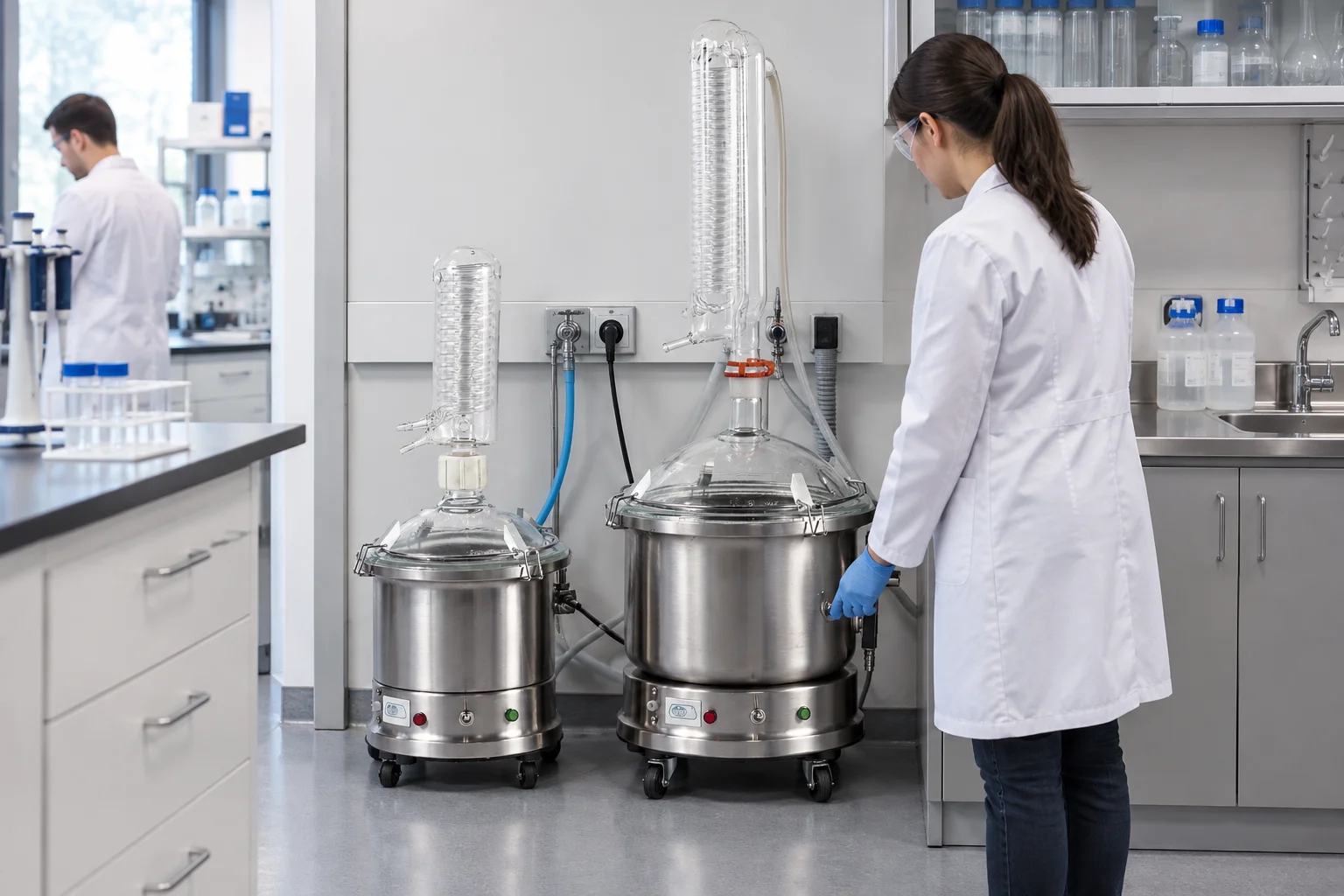
Choosing general labware online can be difficult when two products look alike but only one meets the requirements for an audit or test report. The difference is rarely visible in a photograph. Check the standard, material, measurement range and whether installation or commissioning is included before you buy.
How to choose general labware: start by sorting it into three groups
Consumables, measuring instruments and laboratory equipment need different checks. Applying the same criteria to all three can mean overspending on one item and choosing an unsuitable option for another.
Consumables and glassware
Beakers, flasks, watch glasses, plates and pipettes are usually selected by volume and usage. Consider how much you use each month, how often you need to reorder, the type of glass or plastic, the tolerance for volumetric items, and whether the item is single-use or reusable. There is no need to compare for weeks: order what you use and adjust the quantity as needed.
Measuring instruments
Viscosity flow cups, thermometers, balances and density meters are selected by standard and range. An instrument that measures outside the range of your sample is not necessarily a poor instrument, but it is not useful for your application.
Laboratory equipment
Autoclaves, ovens, centrifuges and baths are purchases intended to last for years. Include electricity consumption, maintenance, spare parts and, in many cases, installation in your decision. The purchase price is only one part of the total cost.
Check the standard before choosing labware supplies
When results are sent to a customer, supplier or organisation, the method is what validates the measurement. For example, the Flow Cup with Handle from JP Selecta is available in two versions that are not interchangeable. One complies with DIN 53211 and has a 4 mm orifice; the other meets ASTM D-1200 and has a 2.53 mm orifice. If your specification or internal procedure requires DIN 53211, the ASTM version may give a correct reading, but it will not be comparable with the result you need.
Next, check the range. The DIN version with a 4 mm orifice covers 90 to 700 cSt, with flow times from 25 to 100 seconds. If your sample is much less viscous, the flow time can be so short that timing error affects the measurement. Also check the material: the cup is made from stamped, calibrated and chrome-plated brass, has a 100 ml capacity and a handle so you can use it without resting it on the bench. The chrome plating helps keep the outlet orifice stable against wear and cleaning solvents.
Use this order: standard, range, material. If the product information does not provide all three, you are guessing rather than comparing.
Burette stand options and mounting: avoid buying more than you need
This is an area where it is easy to buy a larger setup than necessary. For a one-off bench setup involving a funnel, burette or condenser, the Rod Base Support is a practical option. It anchors a 12 mm rod directly to the bench without additional structures. It is available in vertical and parallel configurations, depending on how you want the setup oriented in relation to the edge of the bench.
The Modular Support Stand is a different type of system. It is dismantlable, can be adapted to different configurations and comes with the required components. It makes sense when you assemble and dismantle setups frequently, need to hold several items at once, or have a setup heavy enough that an individual base is not sufficient. It is available in duralumin or stainless steel, in three sizes: 700 × 1000 mm, 1000 × 1000 mm and 1000 × 2000 mm.
| Criterion | Rod Base Support | Modular Support Stand |
|---|---|---|
| Type of setup | One item on the bench | Several items, configurable |
| Configurations | Vertical or parallel | Six models, by material and size |
| Material | Base for a 12 mm rod | Duralumin or stainless steel |
| Sizes | Not applicable | 700 × 1000, 1000 × 1000 or 1000 × 2000 mm |
| Positioning | Economical option | Higher-range option |
When not to choose the modular stand: if your setup is always the same and fits on one rod, the base is sufficient. Stainless steel is justified in corrosive environments, with aggressive cleaning, or where stainless steel is a requirement. Otherwise, duralumin is lighter to handle.
Autoclave sterilization: do not choose a laboratory sterilizer by capacity alone
Capacity matters, but the deciding question is what you need to sterilise. The Steril Pres Steriliser from JP Selecta is a vertical autoclave controlled by a PLC, with an integrated counter-pressure system. Counter-pressure allows liquids to be sterilised without boiling over and being lost when pressure is released. The unit also has fractional vacuum pump purging, which removes air from the chamber before the cycle. This is a critical step for porous loads or closed containers. The chamber is made from AISI 304L stainless steel, as is the outer cabinet.
The range includes four models with two capacities, 80 and 150 litres, and USB and GMP versions. The equipment differences between versions are specified in each model’s product information.
When this is more autoclave than you need
If you only sterilise solid materials, empty glassware and small volumes of media, and never process liquids in closed containers or need cycle documentation, a PLC-controlled, counter-pressure autoclave may offer more than you will use. Before requesting a quote, ask yourself: will I sterilise liquids? Do I need a cycle record? If the answer to both is no, consider a simpler model in the range.
Buying labware online: what to check
The most important factor is not the distance to a physical shop. Check these three points instead:
- Does the product information give you enough to decide? Look for the standard, material, capacity, range and available models. Ask before buying if anything is missing.
- Does the catalogue cover both consumables and equipment? Consolidating orders with one supplier reduces administrative work. Letslab has more than 50,000 product references.
- Will someone take responsibility for the equipment when it arrives? Letslab delivers and commissions equipment; it is not simply left in a box.
Letslab has sold online since October 2008. Browse the laboratory equipment catalogue and compare models using their specifications rather than choosing by photograph.
Checklist before placing your order
- Which standard is required for the result? Check that the specific model complies, not just the product family.
- Does my sample fall within the instrument’s measurement range, with room above and below?
- Will the material withstand the cleaning method I use?
- Am I buying capacity I will never use?
- Does the equipment need installation, a water supply, a drain or a specific electrical supply? Check before delivery day.
- Is there a simpler model in the same range that does exactly what I need?
That last question can save the most money. Choose a higher-range model when you will use the feature that sets it apart, not simply because it looks better on the inventory list.
Where to start with a bench setup
If you are deciding between a simple base and a complete support system, start with the Rod Base Support from JP Selecta. It takes a 12 mm rod and is available in vertical or parallel configurations. Check the product information for the configuration details.
Not sure which one is right for you?
We have been equipping laboratories since 2008. Tell us what you need it for and we will tell you what to buy and what you can do without.
Talk to a specialist