
Blog · Detergentes y desinfectantes para laboratorio
Laboratory glassware detergent: clean before disinfecting
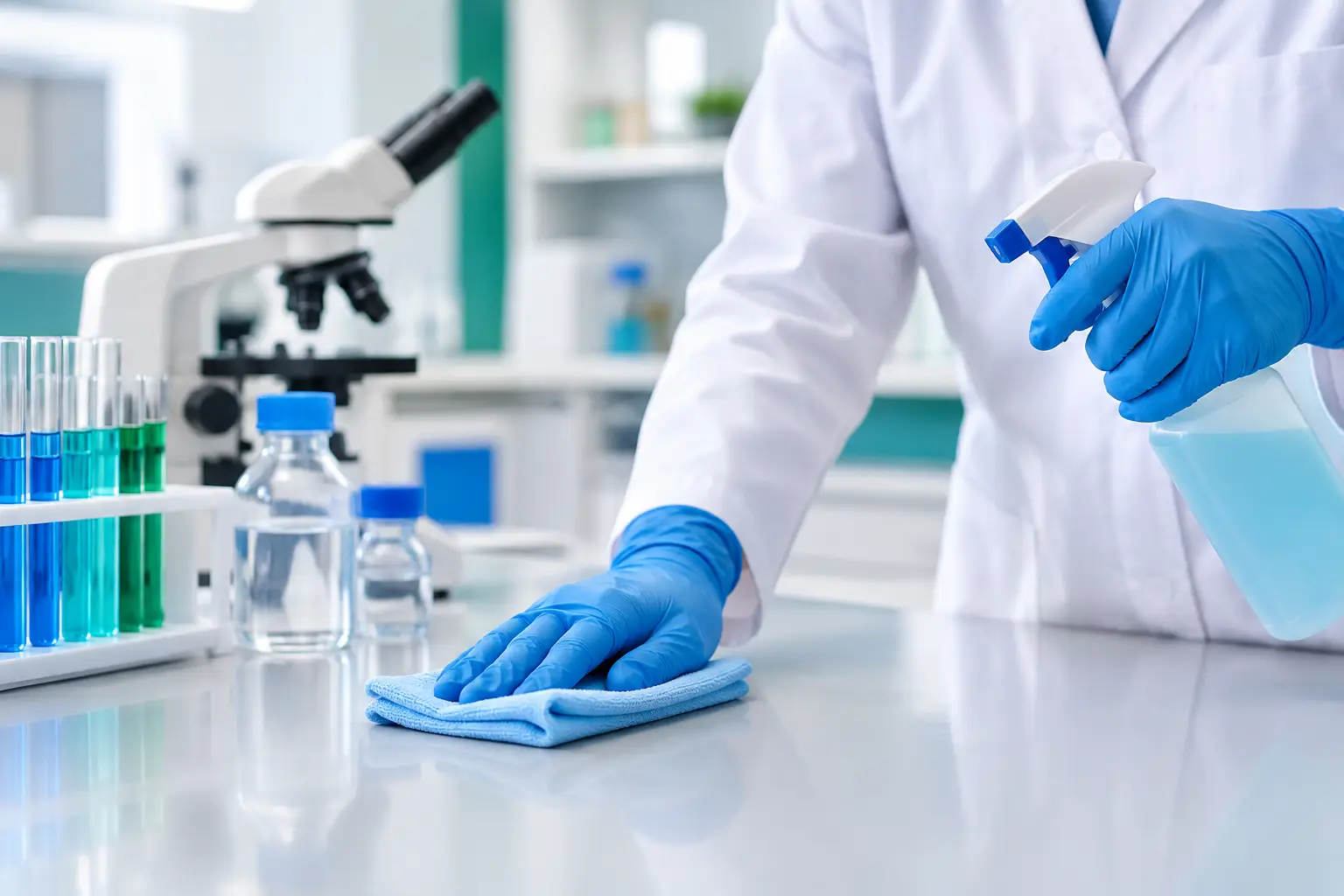
The most common hygiene mistake in a laboratory is applying disinfectant to a surface or item that is still dirty. Organic matter such as culture residues, blood, culture medium, grease and silicone oil can consume the active ingredient and physically protect microorganisms. That is why choosing a laboratory glassware detergent is an important first step: clean first, then disinfect.
Laboratory glassware detergent: cleaning comes before disinfection
Cleaning and disinfection are separate operations with different purposes and products:
- Cleaning with detergent: removes dirt, grease, proteins and chemical residues. It is not intended to kill microorganisms, but it greatly reduces the load before the next step.
- Disinfection with a biocide: inactivates microorganisms on a clean surface, using the contact time stated in the manufacturer’s technical data sheet.
- Sterilisation: uses an autoclave, dry heat or filtration. Detergents and surface disinfectants do not replace an autoclave when a protocol requires sterile material.
If your laboratory has disinfectant but no laboratory detergent, the cleaning step is missing.
Choose a detergent for your washing method
Choose a laboratory glassware cleaner according to whether you wash by hand or use a laboratory glassware washer. The products are not interchangeable: a detergent for a machine is formulated for automatic dosing and complete rinse cycles.
Hand washing, soaking and ultrasonic baths
For hand washing, soaking complex items or using an ultrasonic bath, use Labkem Cleaner Laboratory Detergent for Manual Washing and Immersion 5 L. This biodegradable alkaline concentrate is compatible with borosilicate and soda-lime glass, stainless steel, porcelain, ceramic and laboratory plastics. It acts on grease, oils, blood, cell tissue residues, and chemical and biological contaminants. It rinses clean without leaving residues that could interfere with subsequent tests.
Its three application methods, direct manual washing, prolonged soaking for complex items and ultrasonic cleaning, cover most glassware used in small or medium-sized laboratories.
Washing in a laboratory glassware washer
For machine washing, use Labkem Cleaner Laboratory Detergent for Glassware Washers — Glass, Steel, Plastic and Ceramic. This phosphate-free concentrate is designed for cycles with a complete rinse. It is suitable for borosilicate and soda-lime glass, stainless steel, plastics such as PP, PC and PE, ceramic and porcelain. It is formulated to remove difficult residues including silicone oil, blood, cell cultures, and chemical and biological residues.
The usual rinse product is LABKEM RINSE AGENT A103 Liquid Rinse Aid for Laboratory Dishwashers. This biodegradable, phosphate-free acidic neutraliser contains no surfactants and is dosed during the neutralisation cycle after washing with A102. It neutralises alkaline detergent residues and removes mineral traces that cause white marks on glassware. It can also be used in the prewash. If glassware comes out of the washer with a whitish film, a neutralisation step may be what is missing, rather than a more aggressive detergent.
Quick comparison
| Product | Use | Function |
|---|---|---|
| Labkem Cleaner Laboratory Detergent for Manual Washing and Immersion 5 L | Hand washing, soaking and ultrasonic baths | Concentrated, biodegradable alkaline detergent |
| Labkem Cleaner Laboratory Detergent for Glassware Washers — Glass, Steel, Plastic and Ceramic | Laboratory glassware washer | Phosphate-free alkaline detergent for the wash cycle |
| LABKEM RINSE AGENT A103 Liquid Rinse Aid for Laboratory Dishwashers | Laboratory glassware washer | Acidic neutraliser for the rinse and prewash cycles |
How to choose a surface disinfectant
Once cleaning is taken care of, choose a disinfectant according to practical criteria rather than habit:
- Activity spectrum: bactericidal, fungicidal, virucidal or sporicidal. Not all products cover every target, and non-enveloped viruses are not treated in the same way as vegetative bacteria.
- Contact time: follow the time stated in the technical data sheet for the activity spectrum you need. Wiping a surface and letting it dry immediately invalidates the efficacy test.
- Material compatibility: check compatibility with stainless steel, cabin methacrylate, seals and equipment screens. Hypochlorite that is not rinsed off properly can pit steel, while repeated alcohol use can crack some plastics.
- Residue: sticky residues or surfactant films can cause problems in weighing, cell culture and molecular biology areas.
- Biocide authorisation: a product intended for professional disinfection must be registered as a biocide. If it is listed only as a cleaner, it is not a disinfectant.
Common disinfectant groups and their uses
- Alcohols such as ethanol and isopropanol: evaporate quickly and leave no residue, making them convenient for small surfaces and equipment exteriors. They lose efficacy in the presence of organic matter and do not act on spores. They are flammable, so take care near burners and in cabinets.
- Sodium hypochlorite: broad-spectrum and inexpensive, and commonly used after biological spills. Organic matter inactivates it, it is corrosive to metals, and it degrades over time and in light. Prepare dilutions when they are needed.
- Quaternary ammonium compounds: have good material compatibility and little odour, making them suitable for large surfaces and floors. Their spectrum is more limited and they can leave a residual film.
- Hydrogen peroxide and peracetic acid: break down into less problematic residues and cover a broad spectrum. Depending on concentration, they can be more aggressive towards metals and skin.
No single group is best for every situation. A practical approach is to have one product for routine use that is compatible with your equipment, and another broad-spectrum option for spills and incidents.
When you may not need a disinfectant
- Items that will be autoclaved: if glassware is sterilised afterwards, you need effective washing, not a biocide bath.
- Analytical chemistry laboratories without biological risk: residue-free rinsing and grease removal are the priorities, not antimicrobial activity. A laboratory glassware cleaning detergent such as Labkem Cleaner for hand washing or A102 for a washer can do the job.
- No laboratory glassware washer: do not buy A102 or A103. They are designed for machine dosing and cycles. Choose a hand-washing detergent instead.
- White marks on glassware: do not switch detergents just for a whitish film. Add a neutralisation cycle with the rinse aid.
- Non-critical surfaces: shelves, closed cabinets and administrative areas can be cleaned periodically with detergent, without a biocide.
Common mistakes that undermine a cleaning protocol
- Disinfecting without cleaning first. This is the most common mistake.
- Keeping prepared dilutions in an unlabelled, undated spray bottle for weeks.
- Mixing products to make them more effective. Never mix disinfectants with each other or with detergents unless the manufacturer explicitly instructs you to.
- Ignoring the contact time stated in the technical data sheet.
- Reusing the same cloth throughout a room and transferring contamination between areas.
- Failing to rinse when the protocol requires it, leaving alkaline or chlorinated residues on the material.
Safe handling of concentrated products
The concentrated alkaline Labkem Cleaner detergents and Rinse Agent A103 carry the hazard statement H318, causes serious eye damage. Wear eye protection and gloves (P280). In case of eye contact, rinse with water for several minutes, remove contact lenses if present and seek immediate medical attention (P305+P351+P338+P310+P321). Dispose of the products according to applicable waste requirements (P501A). They have a density of 1.13 and auxiliary grade, and are intended for laboratory use by trained personnel, not for domestic cleaning.
Which laboratory detergent should you choose?
Explore the laboratory detergents and disinfectants range at Letslab. In brief:
- For hand washing or ultrasonic cleaning: choose Labkem Cleaner for manual washing and immersion.
- For a laboratory glassware washer: use Labkem Cleaner A102 in the wash cycle, and Rinse Agent A103 in the neutralisation cycle if mineral marks on glassware are a problem.
If you are buying just one product and wash by hand, Labkem Cleaner Laboratory Detergent for Manual Washing and Immersion 5 L is the most versatile option: a concentrated, biodegradable alkaline liquid detergent compatible with glass, stainless steel, porcelain, ceramic and plastic, and suitable for all three application methods. The product page includes its technical and safety data sheets.
Letslab has sold laboratory materials and equipment online since October 2008, with more than 50,000 catalogue references.
Not sure which one is right for you?
We have been equipping laboratories since 2008. Tell us what you need it for and we will tell you what to buy and what you can do without.
Talk to a specialist