
Glass separating funnel: how to choose the right type
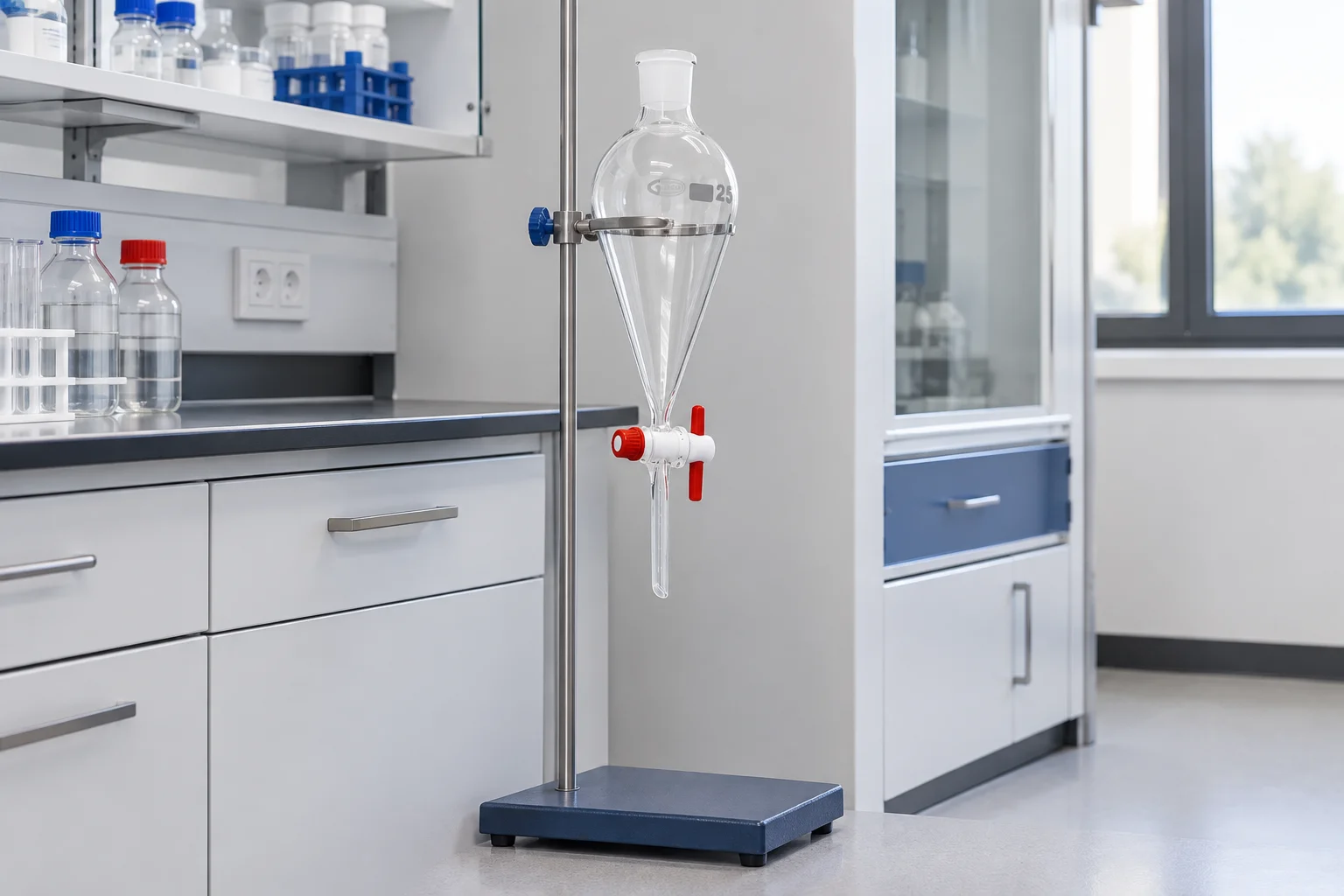
Choosing a glass separating funnel often comes down to two questions: should you get a conical or pear-shaped model, and is a PTFE stopcock worth choosing over a traditional glass one? A glass stopcock can seize after extraction with an alkali, while grease can contaminate a sample and affect the result.
This guide explains which shape suits your work, how a PTFE stopcock changes routine use, what the relevant standard means and when you do not need a separation funnel at all.
What a glass separating funnel is used for
A separating funnel separates two immiscible liquids by density. Common uses include separating the organic and aqueous phases after an extraction, washing a crude reaction mixture and removing aqueous residues after neutralisation. Shake the contents, release pressure by opening the stopcock, allow the phases to settle until the interface is clear, then drain the lower phase.
A separating funnel is not for transferring reagents, adding solids to a flask or filtering. If you need to do one of those jobs, another piece of equipment is more suitable and can cost less.
Conical or pear-shaped separatory funnel?
Conical: the familiar general-purpose shape
The conical shape is a standard choice in organic chemistry and quality control laboratories. Its geometry is forgiving, it is easy to shake and it accommodates a broad range of working volumes. It is also a familiar design for most laboratory users.
The Conical Separating Funnel with PTFE Stopcock and Plastic Stopper, Borosilicate 3.3 is made from LBG 3.3 borosilicate glass. It includes a plastic stopper, so there is no need to improvise a closure when shaking.
Pear-shaped: for a clearer interface with small samples
The pear-shaped design concentrates the lower phase in a smaller volume. This makes the interface easier to see and can reduce product loss by limiting how much remains spread over a broad surface. It is useful when working with small sample amounts, when the two phases have similar densities or when an emulsion makes the interface difficult to read.
The Pear-shaped separating funnel with PTFE stopcock borosilicate 3.3 Glassco is made from 3.3 borosilicate glass and complies with DIN / ISO 4800. It is supplied in a box of 16, which can suit laboratories that perform extractions in series and need replacement units available.
Comparing the two separating funnels
| Feature | Conical | Pear-shaped |
|---|---|---|
| Manufacturer | LBG | Glassco |
| Material | LBG 3.3 borosilicate glass | 3.3 borosilicate glass |
| Stopcock | PTFE, no lubricant required | PTFE, no grease required |
| Top closure | Plastic stopper included | Not specified |
| Standard | Not specified | DIN / ISO 4800 |
| Pack | Single unit | Box of 16 |
For routine extractions with medium sample volumes, choose the conical funnel. For small amounts, difficult interfaces or work where minimising sample loss matters, choose the pear-shaped model. If a teaching laboratory needs several units, the box of 16 pear-shaped funnels is a practical option.
Separatory funnel stopcock: PTFE or glass?
A ground-glass stopcock needs grease to seal. Grease can contaminate the sample, migrate into the organic phase and cause the stopcock surfaces to seize if it is not cleaned properly or the funnel is used with bases. A seized glass stopcock can mean a long cleanup and, sometimes, a broken funnel.
PTFE is inert to most organic solvents and acids, does not require lubricant and does not seize. Adjust it with the retaining nut. Both funnels described above have a PTFE stopcock, which avoids the need for grease in routine use.
Why choose 3.3 borosilicate glass?
Borosilicate 3.3 is a standard technical glass for laboratory use. It withstands acids, bases and common organic solvents, as well as the temperature changes involved in an extraction with a cold solvent and a warm crude mixture. Avoid a glass separating funnel when its glass type is not specified, especially if you plan to use chlorinated solvents or an acid wash.
What DIN / ISO 4800 means
ISO 4800 standardises separating and dropping funnels. It provides reproducible dimensions and tolerances. The Glassco model fits standard supports and rings, and can be replaced with another funnel complying with the same standard without rebuilding the setup. In an accredited laboratory, noting the standard in the inventory can also make equipment identification more straightforward.
When not to use a glass separating funnel
Adding solids to a flask
Removing the stopcock from a separating funnel to add powder to a reaction flask is a common mistake. The powder can block the outlet, product can be lost and an expensive piece of glassware can get dirty. Use a Borosilicate Powder Funnel with Ground Glass Joint instead. Its wide outlet helps prevent blockages from powders, granules and crystals. The standard ground-glass joint fits directly onto a flask with a matching cone, without an adapter.
Separating a solid from a liquid
Decanting does not filter. To recover a precipitate or clarify a suspension, use a filter plate. Pobel’s sintered-glass immersion filter can be placed directly into the suspension, avoiding transfers and the sample losses they can cause. It is available in five porosities: 0 and 1 for coarse particles, 2 for general use, 3 for medium to fine filtration and 4 for retaining fine particles in analytical applications.
Separating two very different phases once in a while
For an occasional separation of liquids with very different densities, a basic funnel and careful use of a pipette may be enough. A separating funnel is most useful when extraction is routine, rather than a one-off task.
How to extend the life of your funnel
- Remove the PTFE stopcock for cleaning so solvent is not left trapped between the plug and the body.
- Do not overtighten the retaining nut during storage. PTFE can flow at room temperature and deform under sustained pressure.
- Release pressure early and often while shaking, especially when using bicarbonate or volatile solvents.
- Store the funnel with its stopper in place, supported by a ring or rack, never on its stem.
- Use backlighting to check the interface. With a pear-shaped funnel, this is usually less necessary, which is one of its practical advantages.
Choosing the right separating funnel for your work
You can compare other shapes, ground-glass joints and sizes in the funnels category.
For regular liquid-liquid extractions and a single funnel with a stopper included, choose the Conical Separating Funnel with PTFE Stopcock and Plastic Stopper, Borosilicate 3.3. For small samples or interfaces that are difficult to read, the Pear-shaped separating funnel with PTFE stopcock borosilicate 3.3 Glassco is the more suitable choice.
Not sure which one is right for you?
We have been equipping laboratories since 2008. Tell us what you need it for and we will tell you what to buy and what you can do without.
Talk to a specialist