
Blog · Microscopios biológicos
Optical vs Digital Microscope: Which Should You Choose?
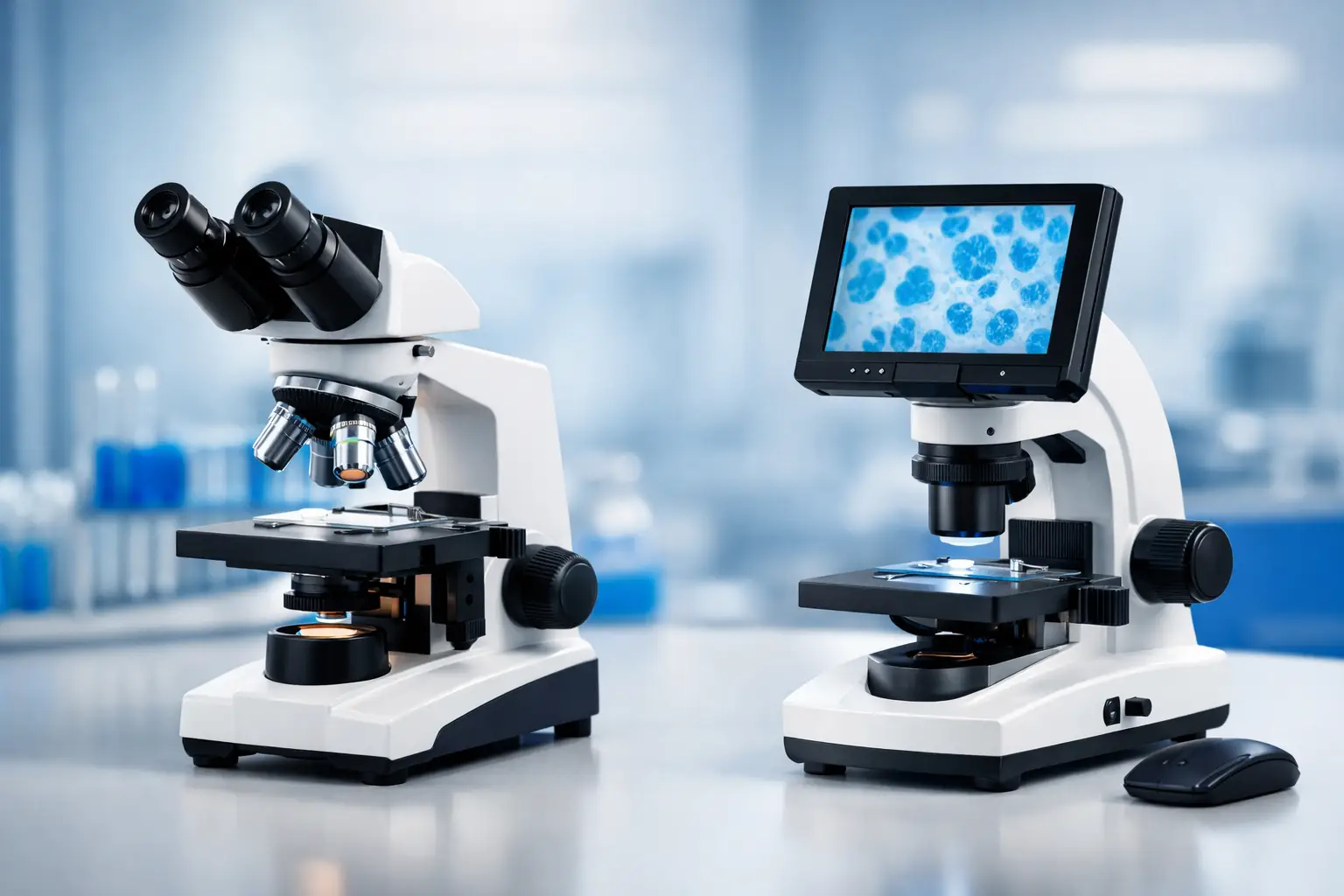
When a laboratory considers investing in a new imaging system, the optical vs digital microscope decision quickly becomes a practical one. It affects the work the team can carry out, how results are documented, how much time staff spend on each analysis and, of course, the available budget. The right choice is not the one that is best in the abstract, but the one that fits the laboratory's day-to-day work.
Optical vs digital microscope: the key difference
A conventional optical microscope forms an image using eyepieces and objective lenses. The user views the sample directly and adjusts the focus, illumination and magnification while observing it. This is a mature, widely used technology with established applications in teaching, quality control, microbiology, histology and many other fields.
A digital microscope captures an image with a sensor and displays it on a screen. Some systems replace the eyepieces entirely, while others combine a screen with conventional viewing. Their value is not simply that the image is digital. They can also bring image capture, measurement, storage, traceability and sharing into the same workflow.
In practical terms, an optical microscope prioritises direct viewing, while a digital microscope prioritises viewing, documentation and image management. In many laboratories, this difference matters more than nominal resolution or magnification.
When an optical microscope is the right choice
An optical microscope remains the most straightforward choice for many laboratories because it offers a strong balance of performance, cost and ease of use. It is a reliable option for routine observations, technical training, visual sample inspection and work that does not require continuous digital records.
It can also be a good fit when users are already trained in conventional microscopy. The learning curve is shorter, maintenance is more predictable and reliance on software is eliminated or kept to a minimum. This matters in laboratories where the priority is to observe samples clearly and quickly without adding unnecessary technology.
Many professionals also value the direct view through the eyepieces, particularly for fine focusing, scanning the field of view and repeatedly examining biological or material samples. This does not always translate into a measurable improvement, but it can make the experience more comfortable for some users.
The limitations become clear when images need to be shared, stored or included in work records. If documentation is a routine requirement, a conventional microscope may need an attached camera, adapters and additional setup, which is not always efficient.
Operational advantages of optical microscopes
Optical microscopes can provide a more accessible starting point for professional-grade configurations. They also allow the investment to be phased: buy the microscope first, then add compatible image-capture accessories if the need arises. This modular approach can suit laboratories working with staged budgets.
There is also a wide choice of configurations for specific techniques, including brightfield, phase contrast, polarisation and fluorescence. Where protocols are already established, this makes it easier to match the microscope to the application without paying for digital features that will not be used.
Where a digital microscope stands out
A digital microscope makes sense when the person at the instrument is not the only person who needs to see the sample. Sharing an image with a quality manager, an R&D team, a client or a training group changes the workflow. A screen that several people can view at once reduces delays, avoids isolated interpretations and improves traceability.
The benefits are particularly clear in laboratories with demanding documentation requirements. Capturing, labelling and storing images, then associating them with a file or batch, is part of the process rather than an optional extra. In this setting, a digital microscope can improve efficiency, not just convenience.
Digital viewing can also improve ergonomics during extended use. Looking at a screen may reduce neck and eye strain at some workstations, especially during long sessions or collaborative reviews. It is not necessarily more comfortable for every user, but it can be a practical advantage in certain working environments.
Some models also include software for measurement, annotation, image comparison and report generation. For quality control, defect analysis, surface inspection and technical teaching, these functions can reduce manual steps and help limit errors.
The total cost of a digital microscope
The main drawback is often the total cost. Consider more than the instrument itself: the sensor, screen and software all matter, as does any licensing and compatibility with the laboratory's existing systems. A low-cost digital microscope may look adequate on paper but fall short in sharpness, colour, latency or ease of use.
Check how updates, file exports and technical support are handled. For a professional purchase, these factors matter as much as the specifications. A well-specified instrument that does not fit into the daily workflow can create friction.
Image quality depends on more than the format
A superficial optical vs digital microscope comparison often boils down to which one produces the better image. In reality, image quality depends on several factors: objectives, illumination, sensor, digital processing, monitor and system setup. The format alone does not determine the result.
A good optical microscope with well-corrected optics can provide excellent viewing for many applications. A well-designed digital microscope can also deliver precise images that are more useful for shared or documented analysis. Problems arise when systems from different quality tiers are compared.
Assess image quality in relation to the application. For routine microbiology, teaching or basic histology, an optical microscope may fully meet the need. For industrial inspection, visual metrology, failure analysis or workflows where images must be shared between departments, a digital microscope may offer a clear advantage.
What professional buyers should consider
The right decision rarely depends on a single specification. Start by defining the instrument's main purpose. A single-user station for routine observation is not the same as a shared system for documented quality control. A university laboratory, where group viewing may be important, also has different needs from a quality-control line with tight turnaround times.
Then review five factors: how often the microscope will be used, whether images need to be captured, how many people will use it, the traceability requirements and the total cost of implementation. If image capture is occasional, an optical microscope with a camera may be enough. If documentation is part of the daily process, a digital system becomes more compelling.
Consider ergonomics as an operational requirement, not an aesthetic preference. An instrument used for hours across multiple shifts needs to be comfortable, stable and easy to adjust. Staff training matters too. The more intuitive the system is for the people who will use it, the lower the hidden cost of adoption.
Choosing an optical or digital microscope for your application
For teaching and training, digital microscopes offer clear advantages through shared viewing and the ability to explain structures on screen. In quality control, the right choice depends on the inspection. If recurring visual evidence is required, digital systems are often more efficient. If the task is mainly quick visual inspection, an optical microscope remains a valid option.
Optical microscopes remain a strong choice for microbiology, cell biology and histology, thanks to direct visual assessment, familiar operation and the availability of specialised configurations. Digital systems can integrate more effectively with measurement, record-keeping and collaboration for materials analysis, electronics, dimensional verification and defect inspection.
There is no universal answer. A single laboratory may benefit from both formats: optical microscopes for routine work and digital systems for documentation, training or validation.
How to choose without overspecifying
A common mistake is to buy for every possible future scenario rather than the work being done today. This can lead to oversized specifications or paying for features that will rarely be used. The most useful starting point is to identify the problem the microscope needs to solve from day one.
If the laboratory needs reliability, direct viewing and a controlled investment, an optical microscope is often a safe choice. If it needs to share images, record evidence and speed up collaborative reviews, a digital microscope may better justify its cost. If the requirements sit between the two, consider hybrid configurations or optical microscopes that can be upgraded for digital imaging later.
At a specialist supplier such as Letslab, this decision is best based on the actual application, usage levels and operational requirements, rather than on a specification sheet alone.
The best purchase is not the one with the most features. It is the one that fits the workflow, reduces friction and continues to meet the laboratory's needs over time.
Not sure which one is right for you?
We have been equipping laboratories since 2008. Tell us what you need it for and we will tell you what to buy and what you can do without.
Talk to a specialist